Umain Works
AI Hype Is Loud. Real Value Is Quiet.


AI Is Inevitable.
Intelligent Adoption Is Not.
Artificial Intelligence is no longer a speculative trend. It is becoming embedded in how organizations operate, compete, and make decisions. The real question for business leaders is not whether AI matters. It does. The question is whether it will be adopted strategically, or reactively.
Yes, investing in AI makes sense. Choosing not to engage with it today is comparable to refusing computers in the 1990s. Technically possible, strategically short-sighted. Over time, competitive advantage accumulates around those who integrate new capabilities early and intelligently.
But there is an equally important warning: investing blindly can be just as damaging as not investing at all. Technology alone has never created value. It has only generated impact when applied with precision to solve a defined problem: reducing effort, increasing quality, accelerating decisions, lowering cost, or strengthening profitability. AI is no exception.
Where AI Actually Creates Business Value
In my experience, AI creates the most value in activities that are repetitive yet knowledge-based, structured yet dependent on human execution. These are tasks where expertise is applied methodically and predictably, often at scale. When such work can be modeled, AI implementation can significantly improve operational efficiency.
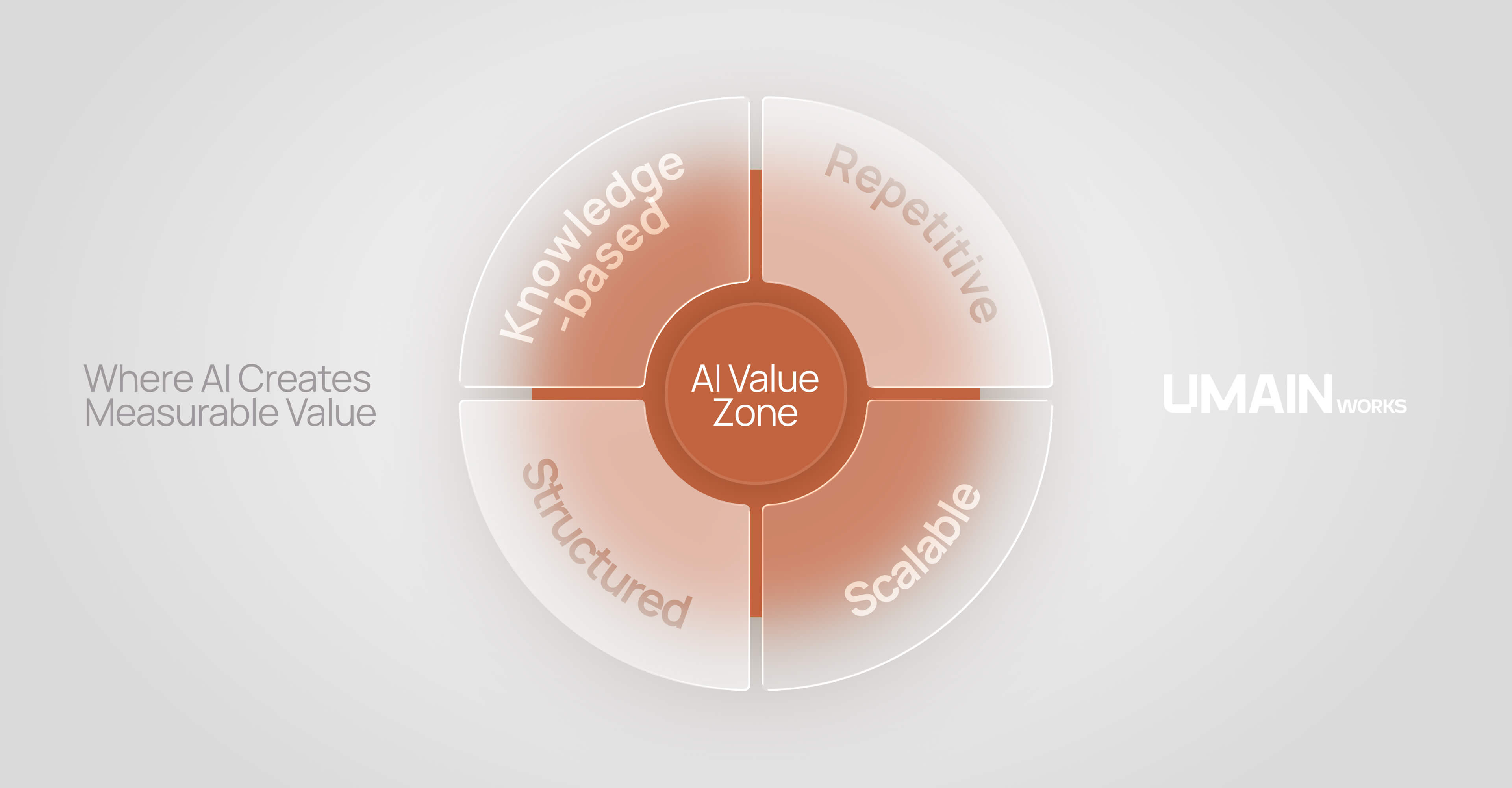
This pattern appears across industries and functions: from analyzing customer purchasing behavior to supporting proposal development, from processing documentation to standardizing outputs. The common denominator is not the sophistication of the technology. It is the structured nature of the task.
However, there is a threshold that must be respected. If a task is inexpensive to execute and the required knowledge is easily acquired, the cost of implementing AI may outweigh its benefits, at least in the current stage of technological maturity. Not every process deserves artificial intelligence. The discipline lies in identifying where it genuinely shifts the economic equation.
Innovation does not automatically equal value. Adoption does not automatically equal advantage.
The Quiet Metric: Freed Human Capacity
The clearest signal of real AI value is whether it liberates human capacity in a measurable way.
At an individual level, we already experience this daily: converting images into structured tables, extracting text from documents, translating content, or drafting communications from structured inputs. These use cases may appear small, but they illustrate the core principle. AI performs structured, repetitive tasks quickly and consistently.
When scaled inside an organization, the impact becomes more visible: analyzing thousands of customer records to identify high-probability buyers and generate tailored outreach, supporting budget preparation by interpreting technical drawings and estimating costs, or automatically formatting commercial proposals to ensure consistency without requiring manual editing. In each case, the outcome is not technological novelty, it is time recovered, errors reduced, and margins protected.
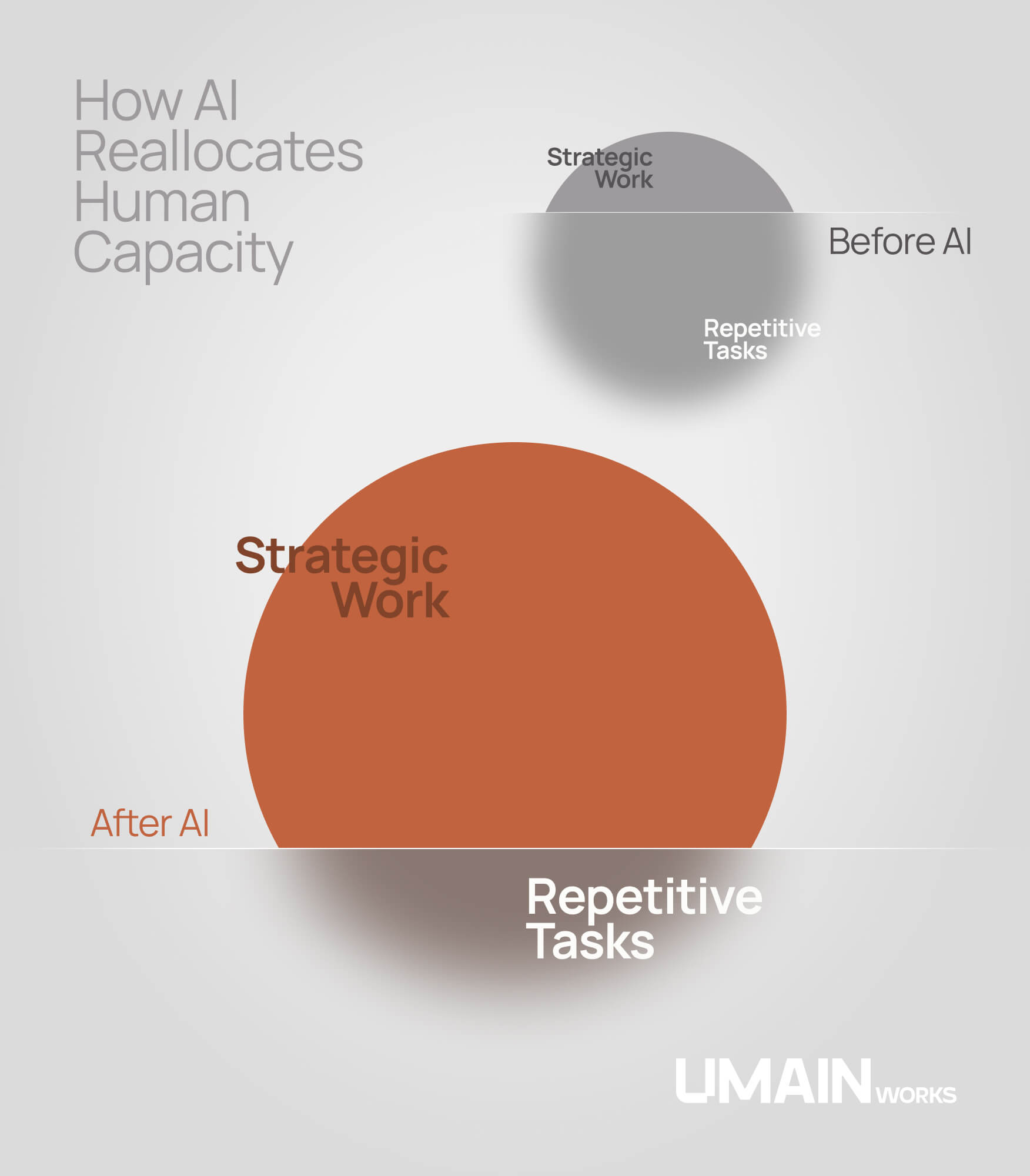
AI does not replace people. It executes tasks that people currently perform. What changes is how human time is allocated. When repetitive work is absorbed by AI systems, organizations gain capacity. That capacity must then be redirected toward higher-value activities like strategic thinking, relationship-building, complex negotiation, and creative problem-solving. The financial impact is measurable because time has a cost per hour. Redeploying it creates return.
The Most Expensive Mistake: Starting with the Tool
One of the most common reasons AI initiatives fail is that organizations begin with the technology rather than the business problem. They identify a promising tool and attempt to integrate it into operations without first defining what they are trying to improve.
This approach inevitably leads to excessive experimentation, workflow disruption, and escalating costs. When the problem is unclear, success cannot be measured properly. When technology becomes the starting point, implementation becomes trial and error.
When the problem is defined first, technology becomes a logical consequence. The difference in execution speed and clarity is significant.
Why Hype Overrides Judgment
This mistake persists because it reflects human behavior. Organizations observe competitors adopting a particular AI solution and feel pressure to replicate the move. The language quickly shifts from “What problem are we solving?” to “We need this as well.”
There is also a reluctance to acknowledge when technology underperforms. Public narratives emphasize success; measured results are less visible. As a consequence, AI hype travels faster than disciplined evaluation.
Following the group can feel safe. But strategic advantage rarely comes from imitation alone.
AI Is Not Always the Right Solution
It is important to state this clearly: AI is not the answer to every operational challenge.
Some inefficiencies require better process design, clearer governance, or traditional automation rather than advanced AI models. Misdiagnosis leads to unnecessary complexity and cost. Not every problem needs machine learning. Sometimes it needs clarity.
Strategic maturity lies in knowing the difference.
Technology Without People Does Not Scale
Beyond diagnosis, there is another critical dimension: change management. Every technological shift alters how people work. Resistance is not an obstacle; it is a predictable human response.
If the individuals who will use AI systems are not involved early in the process, adoption slows and value diminishes. Successful AI implementation is characterized by simplicity and integration. When technology fits naturally into existing workflows and removes undesirable tasks instead of threatening roles, acceptance increases dramatically.
AI should feel like a capable colleague handling repetitive work, not an external force disrupting established routines.
The Strategic Imperative
There is no realistic scenario in which AI disappears. It will become embedded in organizations just as previous technological revolutions did. The real risk is not adoption. It is careless adoption.
Organizations that gain long-term advantage will not be those that deploy the most tools. They will be those that diagnose problems rigorously, evaluate economic return carefully, involve their people thoughtfully, and integrate solutions pragmatically.
AI hype will continue to be loud. It will generate headlines and ambitious claims. Real business value, however, will remain quiet. It will be visible in improved operational efficiency, stronger margins, better decisions, and capacity redeployed where human judgment matters most.
In the end, AI is not about technology. It is about disciplined decision-making.
Start where it matters.
You’re under pressure to act, but clarity comes before tools.
That’s why we usually start with AI Value Discovery, a structured process to identify where AI creates measurable impact, before any solution is implemented.