Umain Works
From AI Strategy to Real Implementation


Strategy Without Execution Creates Frustration. Execution Without Strategy Creates Waste.
Artificial Intelligence is no longer a conceptual discussion inside organizations. The debate has shifted. Leaders are no longer asking if AI matters. They are asking something far more operational:
How do we move from intention to implementation without wasting time, money, and internal credibility?
The gap between AI ambition and AI delivery is rarely technological. It is structural.
Too often, AI is treated as an IT initiative. In reality, it is a business transformation effort that touches processes, data, governance, and people. Technology enables the shift. It does not define it.
Where strategies typically fail is in the transition from executive approval to operational execution. A vision is validated at board level, budgets may even be allocated, but no one translates that ambition into clearly scoped initiatives with defined ownership, sequencing, and measurable outcomes. The strategy may be coherent. The execution framework is not.
Why Execution Breaks Down in Practice
There are consistent warning signs that reveal whether an AI initiative is likely to struggle before it even begins.
One of the most common is data complexity. If producing a simple performance analysis requires manual extractions from multiple systems, spreadsheet consolidation, macros, and cross-department coordination, and the output is already outdated when delivered, the organization does not yet have the operational foundation required for scalable AI.
Fragmented data across geographies, inconsistent taxonomies, disconnected systems—these are not abstract issues. They surface immediately during implementation.
Another warning sign is organizational fatigue. When teams are skeptical due to previous initiatives that promised impact but failed to deliver tangible results, the challenge is no longer technical. It is relational. Trust cannot be rebuilt with another presentation. It is rebuilt with a concrete result delivered on time.
A third signal is unclear ownership. If no business sponsor has the authority to remove obstacles and make binding decisions, execution slows rapidly. AI initiatives without accountability tend to drift.
Recognizing these signals early is not pessimism. It is discipline. It is far less costly to pause an initiative at the outset than to attempt to recover a failing project months later.
What Transforms an Idea into an Executable Initiative
Not every good idea should become a project.
In practice, three elements determine whether an AI initiative is executable:
- A clearly articulated business problem
- Accessible data with minimum quality
- A sponsor with real authority and commitment
Without these elements, an idea remains an interesting conversation.
A business objective must be defined in business terms, not technical terms. “Implement an NLP model” is not an objective. “Reduce contract review time by 40%” is. Clear objectives enable measurable outcomes. Measurable outcomes enable disciplined decision-making.
Prioritization is equally critical. During discovery phases, dozens of potential AI use cases often emerge. But execution requires focus. Dispersion creates activity without delivery. The discipline to separate what is desirable from what is executable is what transforms ambition into a roadmap.
To decide what moves forward, enthusiasm is not enough. The most reliable filters are straightforward:
- Is the business pain real and current?
- Is the data available and usable?
- Is the impact scalable?
Structured impact-versus-feasibility assessments are effective not because they are complex, but because they force honest decisions. A use case may be technically possible yet economically irrelevant. Another may promise high value but depend on unresolved structural constraints.
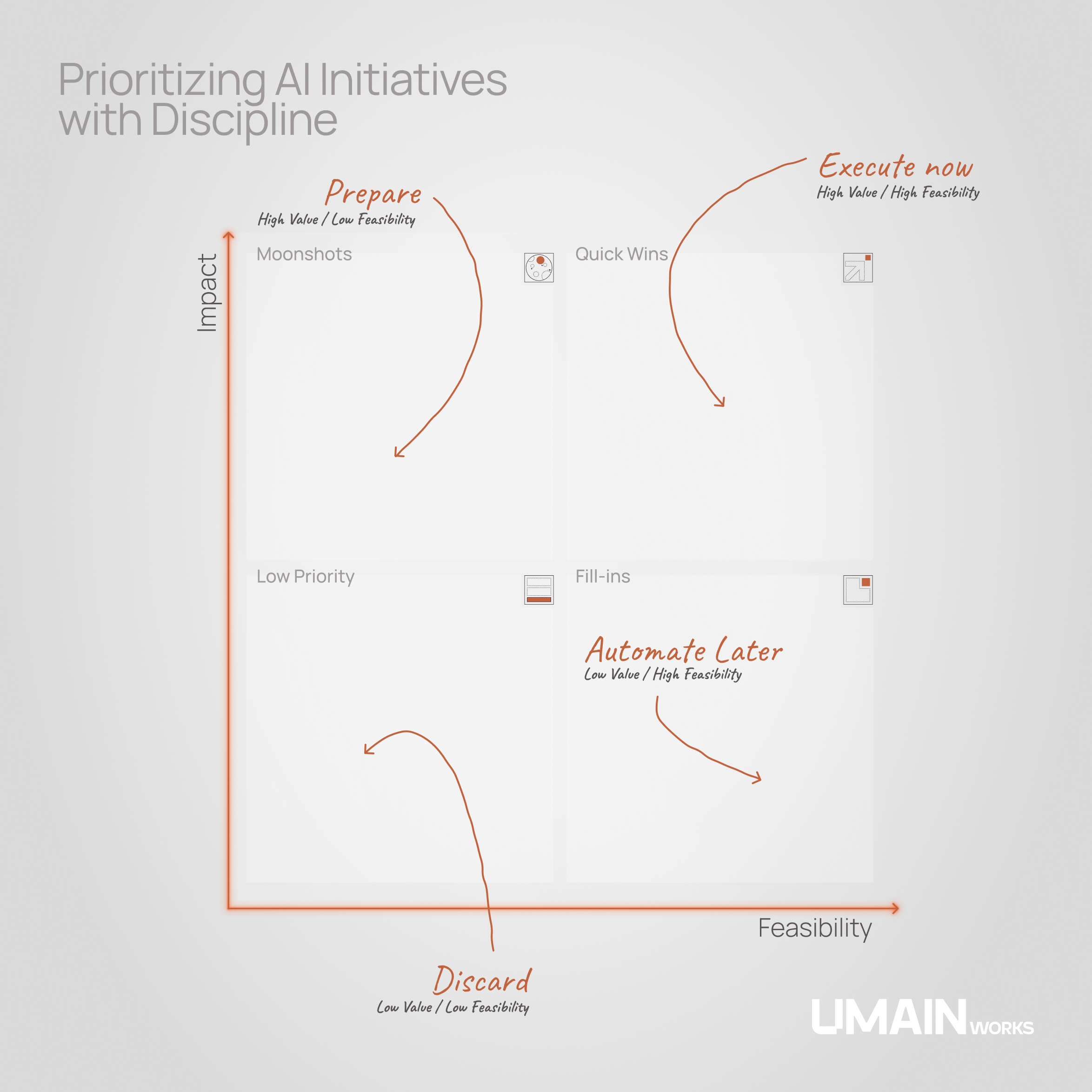
Weak prioritization leads predictably to scope expansion, timeline slippage, and budget overruns. More damaging than financial waste is the erosion of internal confidence. Once an AI initiative fails, future approvals become significantly harder.
What Must Be Defined Before Execution Begins
Before any implementation starts, certain foundations must be explicitly established:
- A business-driven objective
- Clear success metrics
- Identified and validated data sources
- A responsible business owner
- Dedicated team capacity
- Defined go/no-go criteria for each phase
Projects often stall not because they lack ambition, but because governance is unclear. When obstacles emerge, as they inevitably do, there must be predefined mechanisms to decide whether to adapt, escalate, or pause.
Without this clarity, initiatives risk becoming what I often describe as “zombie projects”: alive in budget, inactive in momentum, and slowly draining organizational energy.
Execution clarity does not eliminate complexity. It makes complexity manageable.
Structural Barriers to AI Delivery
Even well-designed initiatives face structural constraints.
Data fragmentation across business units and incompatible systems creates integration challenges that are frequently underestimated. Organizations still operating through informal knowledge, email-based workflows, and unstructured shared files lack the systemic maturity required for scalable AI.
In such environments, the first step may not be advanced modeling. It may be operational organization.
There is also a regulatory dimension that cannot be deferred. Data privacy, GDPR compliance, model explainability, and bias mitigation are not post-implementation concerns. Addressing them late often results in rework, delays, or exposure to risk. Legal and compliance stakeholders must be involved from the beginning.
AI cannot compensate for structural immaturity. It amplifies it.
Discovery Before Delivery
There are moments when the correct decision is not acceleration but clarification.
Whenever significant uncertainty exists regarding the problem definition, data quality, feasibility, or ownership, a structured discovery phase becomes essential. Executive alignment sessions, immersion workshops, cross-functional design exercises, and quantified roadmapping convert ambition into disciplined sequencing.
Discovery is not a delay. It is risk reduction.
In some cases, the outcome of discovery may reveal that foundational improvements are required before AI implementation can deliver value. That realization may feel like a step backward. In reality, it prevents costly misallocation of resources.
The most expensive mistake is not slow implementation. It is implementing before readiness.
Scaling the Right Way
Execution models differ depending on organizational maturity.
A structured AI initiative is appropriate when the problem is clear, scope is defined, and uncertainty is manageable. It enables measurable outcomes within a defined timeframe.
An AI Factory model—continuous, multi-initiative delivery—requires a higher level of maturity: organized data, established governance, prior successful implementations, and internal capability to sustain execution.
Scaling prematurely creates dispersion disguised as ambition. Many initiatives begin. Few reach production.
A practical indicator of readiness for systematic AI delivery is having multiple models operating in production for a sustained period, generating measurable value without constant manual intervention, and with internal leaders capable of replicating the process.
Scale is not created by frameworks. It is created by prepared organizations.
Start Small. Think in Scale.
The first AI initiative should not attempt to solve the most complex problem in the organization. It should generate learning, build confidence, and deliver a visible result.
There is a natural tendency to begin with the most ambitious case. That case is often the most politically exposed and operationally complex. If it fails, the impact extends beyond the project. It affects the credibility of the entire AI agenda.
Execution maturity develops iteratively. Each successful initiative strengthens confidence, capability, and institutional knowledge.
AI does not transform organizations by itself. People decide what will change, how it will change, and whether it will be sustained.
Technology enables. Structure directs. People execute.
That is how intention becomes measurable impact.
Start where it matters.
You’re under pressure to act, but clarity comes before tools.
That’s why we usually start with AI Value Discovery, a structured process to identify where AI creates measurable impact, before any solution is implemented.